How to date a vintage brooch
• If you see a brooch, the first thing to do is to check out its clasp mechanisms. The ‘T-bar hinge and c-clasp’ types (see photos below) were generally used from the 19th Century up until the around 1920s. Some modern artisans still prefer to use a c-clasp – but on modern brooches you’ll probably never see a T-bar hinge.

• Check the length of the pin itself – generally speaking, the longer the pin, the older the brooch (this was perhaps due to clothing being much thicker and heavier in the old days, so a long pin was needed to keep it in place securely).
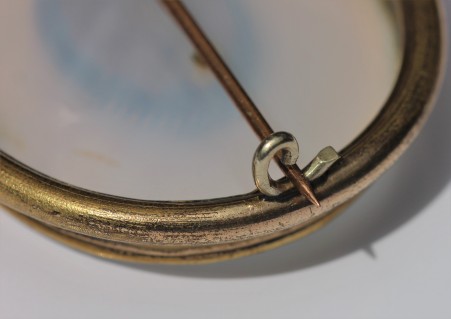 PINS – Generally, the greater the diameter and heavier the material, the older the pin. Heavy pins were acceptable in the loosely woven natural fabrics of the 19th century. The finer weaves and increasing use of synthetic fabrics in the 20th century required pins that were progressively thinner and lighter weight.
• From around the 1910s to 1930s we occasionally see what we call in the trade ‘trombone’ clasps, which are tubular cylinders used to keep the pin itself in place rather than a c-clasp (though c-clasps were still common in this period too). This is general age dating only, and trombones can occasionally be seen on pre-1910s jewelry up to the 1960s.

• Generally speaking you tend to only find the roll-over clasps on brooches made from around the 1960s onward. (Note: Early experimental prototype roll-over ‘safety’ clasps can be seen as early as the 1900s, though these are fairly uncommon)
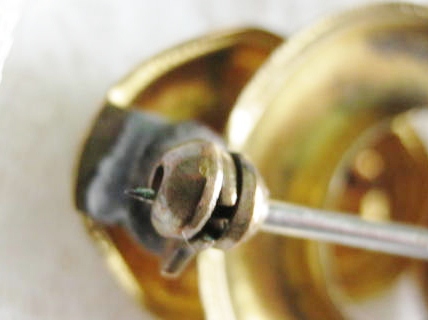
• There are no hard and fast rules to dating a brooch – things other than a pin and clasp must be taken into account, such as design, metal type, glass/ enamel/ stone cuts and types etc; the tips given here are general tips only for general guidance, and you may occasionally find a crude c-clasp on a piece of 1970s jewelry, or a long pin on 1990s jewelry.
Remember – as pointed out previously, these are general guidelines only – you may find c-clasps on modern brooches, and early types of rollovers on pre-1950s jewelry.